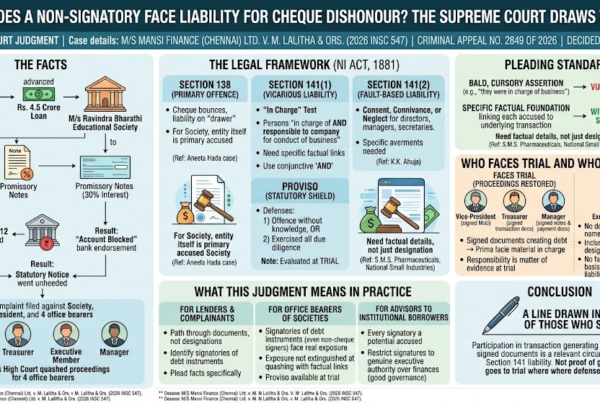

Supreme Court Clarifies Liability of Non-Signatories in Cheque Dishonour Cases: Key Takeaways from Mansi Finance v. Lalitha (2026)
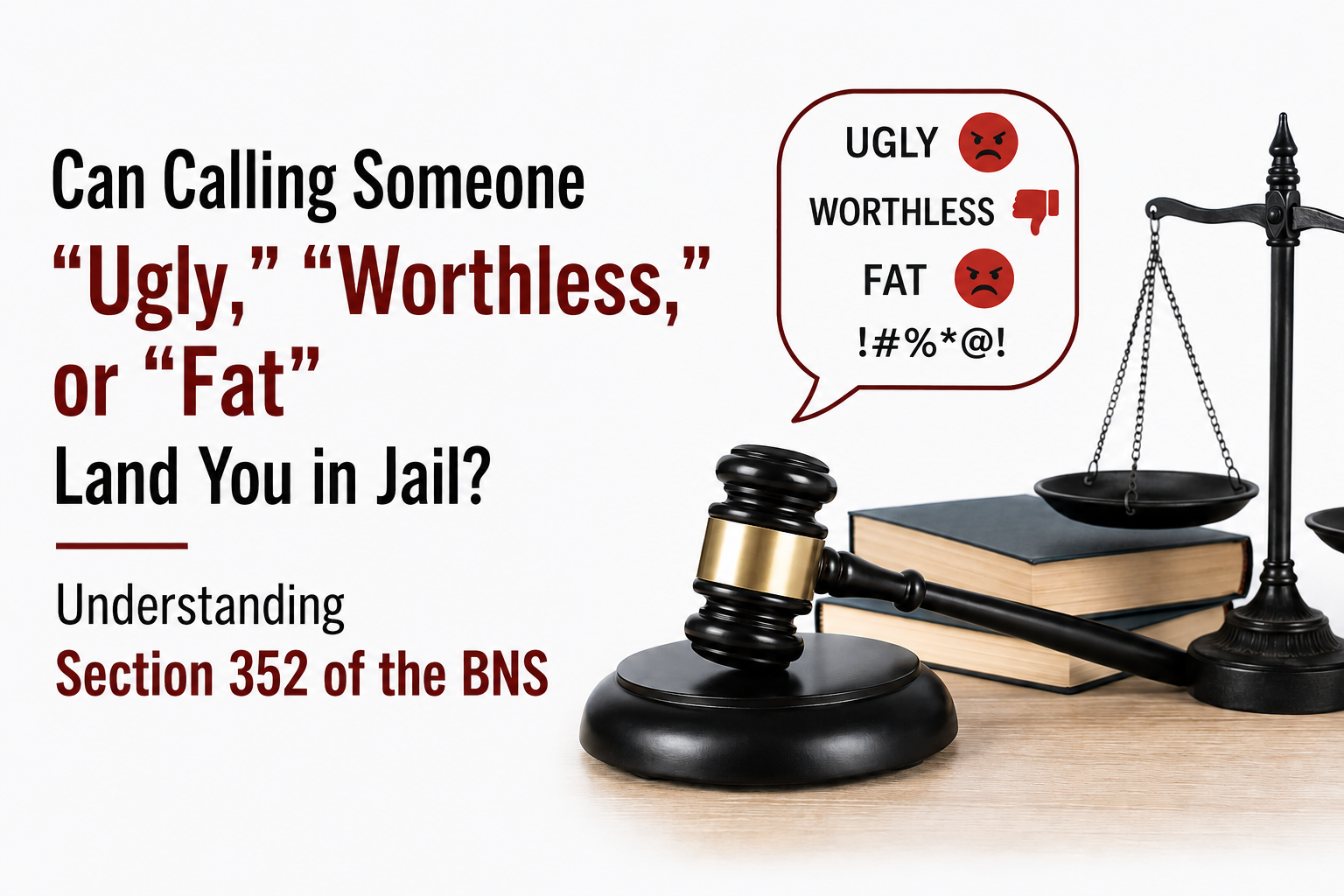
A viral social media post recently claimed that insulting someone by commenting on their skin colour, height, weight, or personal worth could land you in jail under the new Bharatiya Nyaya Sanhita, 2023 (BNS). This has created confusion and concern — especially among young people who often engage in casual banter or heated online arguments.
As a Supreme Court Advocate in Delhi, I regularly advise clients on matters involving free speech and criminal law. Through Qualegal, we have been closely following how courts are interpreting the new criminal laws. In this post, I break down Section 352 BNS in simple terms, explain its real scope, and share what the courts have actually said.
What Does Section 352 of the BNS Actually Say?
Section 352 BNS states:
“Whoever intentionally insults in any manner, and thereby gives provocation to any person, intending or knowing it to be likely that such provocation will cause him to break the public peace, or to commit any other offence, shall be punished with imprisonment of either description for a term which may extend to two years, or with fine, or with both.”
The key elements are:
- Intentional insult
- Provocation that is likely to cause the other person to break public peace or commit another offence
The maximum punishment is up to 2 years in jail, or fine, or both. Importantly, this is not a general law against rudeness or personal insults.
How Courts Are Interpreting Section 352 BNS
Since the BNS came into force, courts have started applying this section, particularly in cases involving online speech and political criticism.
In Nalla Balu v. State of Telangana (2025), the Telangana High Court dealt with a case where a person posted critical tweets against the Chief Minister. The Court held that political criticism, even if harsh or offensive, does not attract Section 352 BNS unless there is clear material showing an imminent threat to public order.
The High Court laid down important guidelines: No FIR under Section 352 should be registered unless there is prima facie evidence of incitement to violence, hatred, or public disorder. This sets a high threshold.
The Court emphasised that context matters. An offensive remark in a private chat, family argument, or closed group will rarely qualify unless it has a real connection to public peace.
Constitutional Safeguards: Article 19(1)(a)
Any reading of Section 352 BNS must respect the fundamental right to freedom of speech and expression under Article 19(1)(a) of the Constitution. As the Supreme Court held in the landmark Shreya Singhal v. Union of India (2015), mere annoyance or offence caused to someone is not enough to criminalise speech. Only speech that incites imminent violence or disorder can be restricted.
Comparison with the Old Law and Other Countries
Section 352 BNS is essentially the successor to Section 504 of the Indian Penal Code. The language is almost identical, and earlier judicial precedents under IPC Section 504 continue to remain relevant.
Internationally, similar laws in the UK, Canada, and Australia also require a clear link to public disorder or breach of peace before criminal liability is attracted — not just hurt feelings.
Practical Takeaways
Section 352 BNS is not a “politeness law”. It is a public order provision designed to prevent insults that are likely to escalate into violence or disturb public peace.
Casual roasts between friends, private arguments, or even strongly worded (but non-inciting) opinions online will generally not attract criminal liability under this section.
However, if an insult is deliberately made in a manner that risks provoking immediate violence or public disorder, it can certainly invite action.
Final Thoughts
The new criminal laws aim to modernise India’s justice system, but they must be applied with caution and in line with constitutional values. Courts have shown a balanced approach so far, protecting both public order and the right to free speech.
If you or someone you know is facing an FIR or legal notice involving allegations under Section 352 BNS or any other provision of the Bharatiya Nyaya Sanhita, it is important to seek timely legal advice.
At Qualegal, we regularly assist individuals and professionals in matters involving free speech, criminal defence, and constitutional rights before the High Courts and the Supreme Court of India.
As a Supreme Court Advocate in Delhi and Advocate on Record, I help clients navigate these complex legal issues with a focus on protecting their rights.
Need help? Feel free to reach out through the contact page for a consultation.