Cheque dishonour cases under Section 138 of the Negotiable Instruments Act are among the most common commercial disputes in India. A frequent issue that arises is whether office bearers who did not sign the bounced cheque can still be held criminally liable under Section 141 of the NI Act.
In a significant judgment delivered on 26 May 2026, the Supreme Court in M/s Mansi Finance (Chennai) Ltd. v. M. Lalitha & Ors. has drawn a clear line on the liability of non-signatories. As a Supreme Court Advocate in Delhi handling numerous matters involving the NI Act, I consider this ruling an important clarification for lenders, borrowers, and legal practitioners alike.
Background of the Case
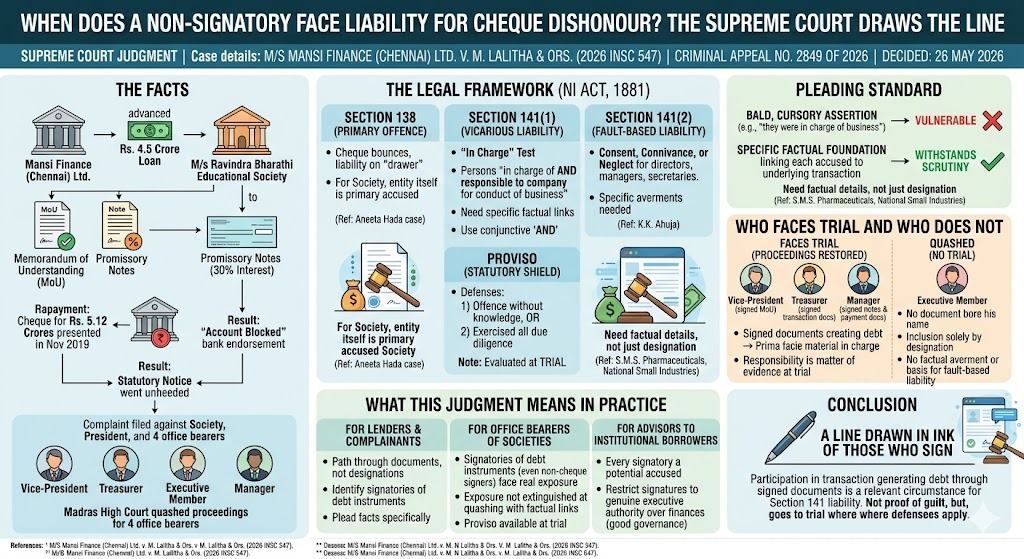
Mansi Finance advanced a loan of ₹4.5 crore to a registered educational society. When a repayment cheque of over ₹5.12 crore was dishonoured with the remark “Account Blocked”, the lender filed a complaint under Sections 138 and 141 of the NI Act.
The complaint named the society as the main accused along with its President, Vice-President, Treasurer, an Executive Member, and the Manager. The Madras High Court quashed the proceedings against four office bearers, holding that the complaint contained only vague, omnibus allegations. The lender then approached the Supreme Court.
Key Legal Principles Under Sections 138 and 141 NI Act
Section 138 creates the primary offence of cheque dishonour and applies to the “drawer” of the cheque. When the drawer is a company, firm, or registered society, Section 141 extends vicarious liability to persons responsible for the conduct of its business.
The Supreme Court reiterated that:
- The company/society must be made an accused (a mandatory requirement as per Aneeta Hada).
- Mere designation (Vice-President, Treasurer, etc.) is not enough. There must be specific averments showing that the person was “in charge of and responsible for the conduct of the business” at the relevant time.
- For directors/officers who did not sign the cheque, liability under Section 141(2) requires averments of consent, connivance, or neglect.
What the Supreme Court Decided
The Court carefully examined the role of each accused based on their involvement in the transaction:
- Vice-President, Treasurer, and Manager — They had signed the Memorandum of Understanding, promissory notes, or other key financial documents related to the loan. The Supreme Court held that such active participation in the transaction provided prima facie evidence that they were in charge of and responsible for the affairs of the society. Proceedings against them were restored.
- Executive Member — His name did not appear on any document related to the loan or the cheque. The Court upheld the quashing of proceedings against him, as mere designation without any connecting averments or evidence of involvement was insufficient.
The judgment emphasises that signatures on debt-creating documents (MoU, promissory notes, loan agreements) can be strong prima facie material to establish liability under Section 141, even if the person did not sign the actual bounced cheque.
Practical Implications
For Lenders & Complainants: Always identify and plead the specific role and signatures of office bearers on key transaction documents. Vague complaints naming everyone are vulnerable to being quashed under Section 482 CrPC.
For Office Bearers & Institutions: Anyone who signs loan documents or financial instruments carries potential exposure in future cheque dishonour cases. Careful delegation and documentation of roles can help manage legal risk.
At Trial Stage: The accused can still take the defence under the proviso to Section 141(1) — that the offence was committed without their knowledge or that they exercised due diligence.
Conclusion
The Mansi Finance judgment provides much-needed clarity: participation in the underlying transaction (evidenced by signatures on relevant documents) is a key factor for fastening liability on non-signatories under Section 141 of the NI Act. However, bare designations without any connecting facts will not suffice.
This ruling strikes a balanced approach — protecting genuine creditors while preventing indiscriminate harassment of office bearers who had no real involvement in the transaction.
At Qualegal, we regularly represent clients — both lenders and accused persons — in complex cheque dishonour and Section 141 matters before the High Courts and the Supreme Court of India.
If you are dealing with a cheque bounce case, facing proceedings under Section 138/141 NI Act, or need strategic advice on drafting complaints or quashing petitions, feel free to reach out.
Need help? Contact me through the contact page for a consultation.