
Supreme Court Clarifies Liability of Non-Signatories in Cheque Dishonour Cases: Key Takeaways from Mansi Finance v. Lalitha (2026)
When we think of the writ of habeas corpus, most people imagine it being used to challenge unlawful detention by the State. But in India, this powerful constitutional remedy has evolved into one of the most effective tools for parents and families fighting for the rightful custody of a child.
Over the years, as a Supreme Court Advocate in Delhi, I have seen firsthand how habeas corpus petitions under Articles 32 and 226 have helped secure the immediate production and protection of minors wrongfully withheld by a spouse, relative, or even in complex cross-border situations. Through Qualegal, I have handled numerous such matters, and this post shares the legal framework, key judgments, and practical insights from my practice.
Understanding the Constitutional and Legal Framework
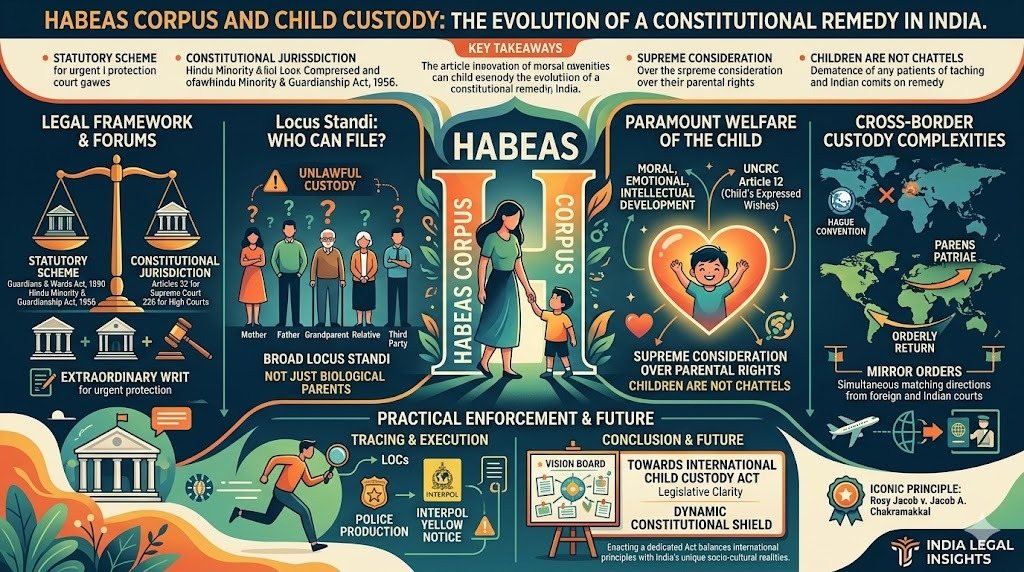
The writ of habeas corpus in child custody matters works alongside statutes like the Guardians and Wards Act, 1890 and the Hindu Minority and Guardianship Act, 1956. High Courts primarily exercise this power under Article 226, while the Supreme Court can be approached directly under Article 32 in cases involving serious fundamental rights violations.
Choosing the right forum is crucial. A High Court decision can sometimes trigger the doctrine of res judicata, affecting further petitions. As an Advocate on Record in Delhi, I always advise clients to carefully evaluate whether to approach the High Court first or directly petition the Supreme Court in exceptional cases.
Who Can File a Habeas Corpus Petition? (Locus Standi)
One of the biggest advantages of habeas corpus over regular civil custody suits is the broader locus standi. It is not limited to biological parents. Grandparents, aunts, uncles, or other close relatives can file if they can show the child is in unlawful custody.
In Syed Saleemuddin v. Dr. Rukhsana (2001), the Supreme Court clarified that the legality of custody and, most importantly, the welfare of the child remain the paramount considerations.
Habeas Corpus vs. Section 25 of the Guardians and Wards Act
Section 25 of the GWA offers a civil remedy, but it can be slow. Courts have held that where the child’s welfare demands urgent intervention, the extraordinary writ jurisdiction under Article 226 should be invoked without delay — as seen in Shilpa Aggarwal v. Aviral Mittal (2010).
However, habeas corpus is not meant to bypass ongoing family court proceedings. It is best reserved for genuine emergencies.
The Paramount Principle: Welfare of the Child
This is the golden thread running through all custody litigation in India. Children are not chattels. As the Supreme Court famously observed in Rosy Jacob v. Jacob A. Chakramakkal (1973), parental rights must yield to what is best for the child’s moral, emotional, intellectual, and physical development.
This principle applies squarely to habeas corpus cases (Gaurav Nagpal v. Sumedha Nagpal, 2009). Courts also give due weight to the wishes of the child, especially as they grow older — in line with India’s obligations under the UN Convention on the Rights of the Child.
Cross-Border Custody and NRI Cases
India is not a signatory to the Hague Convention on International Child Abduction. In such cases, Indian courts exercise parens patriae jurisdiction and always prioritise the child’s best interests.
Landmark cases such as:
Dhanwanti Joshi v. Madhav Unde (1998)
V. Ravi Chandran v. Union of India (2010)
Surya Vadanan v. State of Tamil Nadu (2015) — which popularised “mirror orders”
…have shaped how courts handle NRI and OCI child custody disputes. Recent judgments like Yashita Sahu and Vasudha Sethi have further clarified that Indian courts retain jurisdiction even for foreign citizens or OCI cardholders temporarily in India.
The guiding principle, beautifully articulated in Elizabeth Dinshaw v. Arvand M. Dinshaw (1987), remains: custody decisions must focus solely on what best serves the interest and welfare of the minor.
Enforcement: Turning the Order into Reality
Getting the writ is only the first step. Enforcement often requires police assistance, contempt proceedings, or coordination with Child Welfare Committees. In international cases, tools like Look-Out Circulars, MEA intervention, and Interpol notices become relevant, though courts caution against overuse of extreme measures (as observed in Smriti Madan Kansagra v. Perry Kansagra).
Final Thoughts
The writ of habeas corpus has become a dynamic, child-centric constitutional remedy in India. While judicial innovation has filled many legislative gaps — especially in cross-border disputes — dedicated legislation addressing international child custody would bring greater clarity and predictability.
If you are facing a child custody dispute involving unlawful retention of your child, whether within India or across borders, timely legal advice is critical.
At Qualegal, we regularly assist clients in complex habeas corpus and custody matters across High Courts and the Supreme Court of India.
As a Supreme Court Advocate in Delhi and Advocate on Record, I personally handle such cases with a strong focus on the child’s welfare.
Need help? Feel free to reach out through the contact page for a consultation.
Red Flags to Avoid
- “Guaranteed Win” Promises: No ethical lawyer can guarantee the outcome in the Supreme Court. Walk away immediately if someone offers 100% success.
- Disorganized Approach: If the chambers appear chaotic or lack proper systems, think twice. The Supreme Court registry is extremely strict about deadlines and documentation.
- Overpromising Without Substance: Be cautious of advocates who focus more on marketing than on actual legal capability.
Final Thoughts
- Choosing the right Supreme Court Advocate in Delhi is ultimately about trust, competence, and ethical practice. Look for someone who combines strong credentials as an Advocate on Record with deep domain knowledge, transparent communication, and a client-first approach.At Qua Legal, we are committed to providing honest advice and strategic representation before the Supreme Court of India.If you have a matter pending or proposed before the Supreme Court, feel free to reach out. We offer confidential consultations and clear guidance based on the specific facts of your case.
Ready to discuss your Supreme Court matter? Contact us today to schedule a consultation with Shivam Kumar AOR, Advocate on Record, Supreme Court of India.